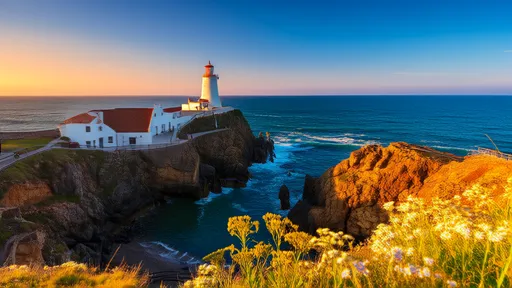
At the southwestern tip of Europe, where the land crumbles into the Atlantic, there exists a place of profound geographical and symbolic resonance. The Cape of Sagres, in Portugal, carries an inscription that has echoed through centuries of exploration and human ambition: "Aqui, onde a terra se acaba e o mar começa"—"Here, where the land ends and the sea begins." More than a poetic observation, this phrase distills a moment of irreversible transition, a threshold between the known and the unknown that defined an era and shaped the modern world.
The power of this statement is rooted in its historical context. For much of human history, the ocean was the ultimate frontier, a realm of monsters, mysteries, and certain death. Ancient maps often depicted the edges of the world with the chilling warning: "Hic Sunt Dracones"—"Here be dragons." To stand at the westernmost point of the continental landmass was to stand at the very edge of the imaginable. It was from this precipice that Portugal, under the visionary guidance of Prince Henry the Navigator, launched the Age of Discovery. The sea that began at this point was not an end, but a beginning—a highway to empires, new cultures, and a radical rethinking of the globe.
This was not merely a physical launching point for caravels; it was an intellectual and psychological pivot. The phrase captures a unique European, and particularly Portuguese, mindset of the 15th century. It is a statement of finality coupled with immense potential. The land ends, a fact that could be interpreted as a limitation. But in that very ending, the sea begins, offering infinite possibility. This reframing of an ending as a beginning is the essence of the explorer's spirit. It represents a conscious turning away from the safety and confines of the continent towards the vast, uncharted, and perilous expanse of the ocean. It is an embrace of the unknown, driven by a blend of curiosity, faith, and a relentless pursuit of wealth and glory.
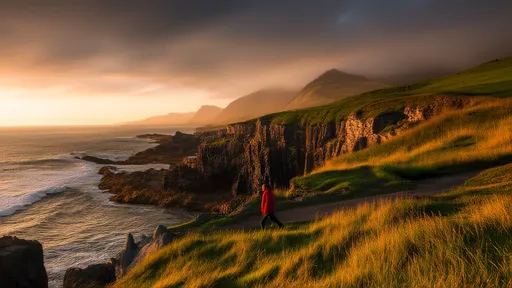
The geographical reality of the location amplifies its symbolic weight. The Cape of Sagres, and the nearby Cape St. Vincent, are battered by powerful winds and relentless waves. The cliffs are stark and dramatic, offering a panoramic view of an endless blue horizon. To stand there today is to feel a small fraction of the awe and trepidation those early navigators must have felt. The wind seems to carry whispers of past voyages—of Bartolomeu Dias rounding the Cape of Good Hope, of Vasco da Gama finding the sea route to India, and of Ferdinand Magellan embarking on a journey that would circumnavigate the Earth. The sea that begins there truly did become the starting point for the first globalized world, connecting continents and cultures in ways previously unimaginable.
Yet, the sentiment extends far beyond its historical origins. "Where the land ends and the sea begins" has evolved into a universal metaphor for any moment of critical transition. It speaks to anyone facing a precipice in their own life—the end of one chapter and the daunting, yet exciting, beginning of another. It is the moment before a leap of faith, the deep breath before a major decision, the quiet before a transformative journey. The phrase acknowledges the fear inherent in endings but champions the courage required to set sail into the unknown, trusting that there is something to be discovered on the other side.
In a modern context, this Portuguese maxim resonates with our own era of rapid change and exploration. We face new frontiers not of ocean, but of technology, science, and human understanding. The "land" that ends could be our current paradigms, our outdated systems, or the limits of our knowledge. The "sea" that begins is the digital universe, the potential of AI, the mysteries of deep space, or the journey toward a more sustainable future. The same spirit that compelled sailors to venture into the Atlantic now compels us to venture into these new domains, armed with the same mixture of trepidation and hope.
Furthermore, the phrase carries an environmental significance that its authors could never have anticipated. Today, the point where land meets sea is one of the most vulnerable and dynamic interfaces on our planet. With rising sea levels due to climate change, the "end" of the land is becoming a literal and alarming reality for coastal communities worldwide. The beginning of the sea is now encroaching, a forceful reminder of the power of nature and the consequences of human action. This adds a poignant, double-edged meaning to the ancient words, transforming them from a triumphalist declaration of conquest into a sobering reflection on responsibility and fragility.
Ultimately, the enduring power of "Onde a terra se acaba e o mar começa" lies in its perfect duality. It is both a specific location on a map and a timeless idea in the human psyche. It is about an ending that is also a genesis. It honors the courage to let go of the solid ground of the familiar to embrace the fluid and uncertain potential of what lies ahead. It is a testament to the human capacity to look at a horizon and not see a barrier, but an invitation. To stand at that cape is to understand that every ending is woven into a beginning, and that the greatest journeys start precisely at the point where everything else seems to stop.
By /Sep 1, 2025
By /Sep 1, 2025
By /Sep 1, 2025
By /Sep 1, 2025
By /Sep 1, 2025
By /Sep 1, 2025
By /Sep 1, 2025
By /Sep 1, 2025
By /Sep 1, 2025
By /Sep 1, 2025
By /Sep 1, 2025
By /Sep 1, 2025
By /Sep 1, 2025
By /Sep 1, 2025
By /Sep 1, 2025
By /Sep 1, 2025
By /Sep 1, 2025
By /Sep 1, 2025
By /Sep 1, 2025
By /Sep 1, 2025