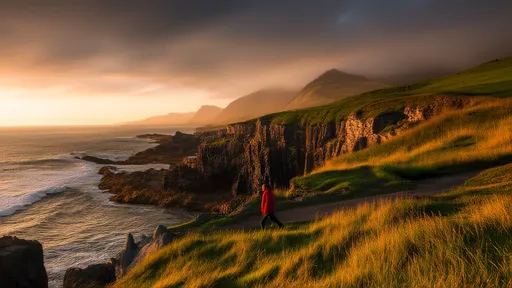
Deep within the rugged embrace of Norway’s western coastline lies one of nature’s most breathtaking masterpieces—the fjords. Carved over millennia by ancient glaciers, these deep, serpentine inlets weave through towering cliffs and mist-shrouded mountains, creating a landscape that feels both primordial and profoundly alive. To journey into the heart of the Norwegian fjords is to step into an epic narrative written by ice, stone, and water—a story of elemental forces and sublime beauty that continues to unfold with each passing season.
The fjords are not merely scenic wonders; they are living, breathing entities. From the thunderous roar of cascading waterfalls to the serene stillness of mirror-like waters, every element conspires to immerse the traveler in a world where nature commands reverence. The air itself carries the scent of pine and salt, of damp earth and distant snow—a fragrance that seems to encapsulate the very soul of this wild, untamed region.
One cannot speak of the Norwegian fjords without mentioning the legendary Sognefjord, the longest and deepest of them all. Stretching over 200 kilometers inland, it is often called the "King of the Fjords," and rightly so. Its scale is humbling; its beauty, almost incomprehensible. Sheer rock faces rise vertically from emerald waters, their peaks often lost in low-hanging clouds, while tiny villages cling to narrow strips of land along the shoreline, their colorful wooden houses dotting the landscape like scattered gems.
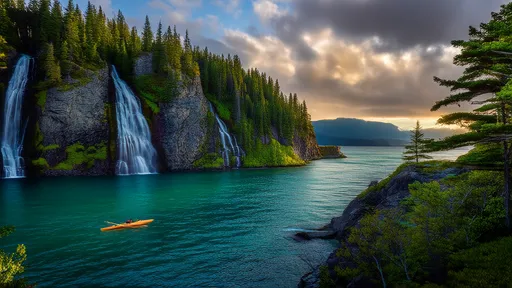
Further north, the Geirangerfjord—a UNESCO World Heritage Site—unfolds like a dramatic theater of nature. Here, waterfalls such as the Seven Sisters and the Suitor plunge hundreds of meters into the fjord, their mist catching the light to form rainbows that arc gracefully over the water. It is a place where myth and reality blur, where local legends speak of trolls and ancient spirits guarding the mountains, and where the raw power of nature feels both exhilarating and humbling.
But the fjords are more than just visual spectacles; they are ecosystems teeming with life. Beneath the surface, cold, nutrient-rich waters support a diverse array of marine life, from schools of herring and cod to seals and porpoises that occasionally break the water’s surface. Above, sea eagles soar on thermal currents, their keen eyes scanning for prey, while on land, reindeer roam the higher plateaus and forests shelter foxes, lynx, and elusive moose.
For those willing to venture beyond the well-trodden paths, the fjords reveal hidden treasures—secret valleys, isolated farms, and tranquil lakes accessible only by foot or boat. Hiking trails such as those in Jotunheimen National Park offer breathtaking vistas, while kayaking through the narrow arms of the fjords allows for an intimate encounter with the landscape, where the only sounds are the dip of a paddle and the cry of a distant bird.
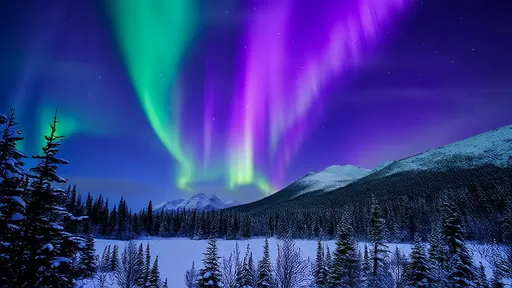
The changing seasons paint the fjords in dramatically different palettes. In spring, the slopes burst into life with wildflowers and budding trees, and melting snow feeds countless waterfalls that roar with renewed vigor. Summer brings endless daylight under the midnight sun, casting a golden glow over the landscape and inviting exploration at all hours. Autumn sets the hillsides ablaze with shades of amber and crimson, while winter transforms the fjords into a silent, snow-clad paradise, where the northern lights often dance overhead in shimmering curtains of green and violet.
Human presence in the fjords is both ancient and resilient. For thousands of years, people have carved out a existence in this challenging environment, building communities that harmonize with—rather than conquer—the land. Traditional farming, fishing, and crafts continue to thrive in many areas, and the cultural heritage of the region is preserved in local museums, stave churches, and folk festivals that celebrate a deep connection to nature and history.
Yet, the fjords are not frozen in time. Modern Norway balances preservation with progress, ensuring that development remains sustainable and respectful of the natural world. Electric ferries glide silently through the waters, solar panels dot remote homes, and an extensive network of hiking trails and eco-lodges allows visitors to experience the fjords with minimal environmental impact. This commitment to sustainability ensures that future generations will also have the opportunity to witness these majestic landscapes in their full glory.
To travel through the Norwegian fjords is to embark on a journey of discovery—not only of nature’s grandeur but also of one’s own place within it. It is a reminder of the enduring power of the wild, the fragility of our planet, and the profound beauty that arises when earth, water, and sky converge in perfect harmony. In the silence of the mountains and the rhythm of the tides, one can almost hear the echo of an ancient epic—a story written not in words, but in stone and ice and light.
Whether seen from the deck of a ship, the height of a mountain, or the quiet solitude of a forest path, the fjords leave an indelible mark on the soul. They are a testament to the artistry of nature and a invitation to slow down, breathe deeply, and remember that we are part of something far greater than ourselves.
By /Sep 1, 2025
By /Sep 1, 2025
By /Sep 1, 2025

By /Sep 1, 2025

By /Sep 1, 2025
By /Sep 1, 2025
By /Sep 1, 2025

By /Sep 1, 2025
By /Sep 1, 2025
By /Sep 1, 2025
By /Sep 1, 2025

By /Sep 1, 2025
By /Sep 1, 2025
By /Sep 1, 2025
By /Sep 1, 2025
By /Sep 1, 2025
By /Sep 1, 2025
By /Sep 1, 2025

By /Sep 1, 2025
By /Sep 1, 2025